AI, some would call it the most transformative invention since the steam engine, has completely changed the world we live in today. For educators and students alike, it has become a major problem, and a gateway for cheating, and schools now have to create AI policies that severely punish students for academic dishonesty. However, schools are trying to find ways to work with AI in a way that benefits students without letting them cheat.
For students to educate themselves on proper uses of AI, but Hackley’s handbook seems to be missing these rules. Students should refer to “There’s actually very little in the current handbook as it reads in terms of specifically to AI-specific stuff,” said Head of Upper School Mr. King
As schools try to collaborate and control how students work with AI, they find the struggle of working with one of the world’s fastest-changing machines.
“It’s also kind of an evolving conversation. So there’s actually a whole group of teachers who are working on kind of what AI policies and AI directives would look like,” said Mr. King
As students are brought through the upper school and become tempted to use AI for the benefit of their grade, they miss out on the purpose of their education. “So yeah, I mean, the point of an education is to sort of build a foundation of skills, one of which is critical thinking,” said Mr. King
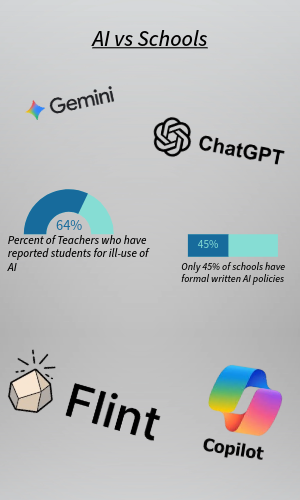
Large language models like ChatGPT can automate students’ work and assignments in a matter of seconds, but along with the fact it can be wrong at times, it deprives students of critical skills like reading, writing, and communicating their thoughts. However, in today’s world, AI is all around us, and if you don’t adapt to the environment around you, you can be left behind in an era of innovation and technology. As a result, “Hackley has a subscription to something called Flint, which is a school-linked AI, which is different from ChatGPT or Claude or Gemini. Because what Flint does is Flint actually tracks your sort of search history. So we could sort of have a sense of, hey, if you’re gonna have a dialogue with AI around something, we can follow along with it in a way that we’re not doing that if it’s, you know, your private chat GPT,” said Mr. King
Programs like Flint provide a perspective into the use and power of AI, while allowing teachers to monitor students’ use of it. This type of collaboration with AI is a standard of Hackley, integration into the real world, preparing students for the future beneath our feet.
AI is a great tool that surrounds our everyday life in every aspect; however, its use for students should be moderated, but not shut off. When using AI in our school work, we should remind ourselves how, and not why, we are doing things using AI as a tool, not an outlet. “I’m cautiously optimistic that we’ll be able to kind of grapple with it in thoughtful and meaningful ways that feel, um, that feel like it’s purposeful and useful to education. But I’m also aware, AI is also a multi-billion dollar business, and faster is going to be better and more profitable,” said Mr. King