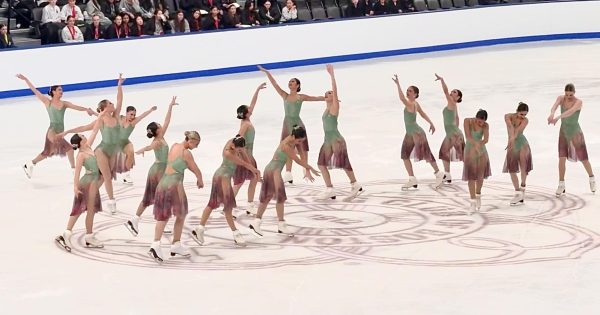
Synchronized figure skating is a sport you probably didn’t know existed. It’s a sport where 16 young athletes passionately perform on the ice with their heart and soul, just for no one to recognize its beauty. Finally, it was announced to be introduced in the Youth Olympics for 2028, but with a condition of only 9 skaters instead of the usual 16.
After the Youth Olympics, skaters hope it will get into the real Olympics.
Synchronized skating takes place through many different divisions, whether as a little elementary school student holding hands in a circle, or as a high school or college student performing risky lifts on the international stage.
Each level gets more and more competitive as you go up, with increasing pressure, especially at the international lines, Junior and Senior.
A program contains various elements and tricks, creating different shapes and transitions. Around half of your points come from these technical components, while the other half come from composition, presentation, and skating skills. The judges use IJS, the International Judging System to give scores to the teams, where the highest score wins the gold.
In Synchro 9, there will be a different system for judging. This could be beneficial or detrimental compared to the original familiar system.
For the longest time, these hard-working skaters wanted to be recognized in the Olympics to showcase their work and dedication for the world to see, but they never made it. Synchronized skating is too expensive, with too many skaters on a team, and is not recognized enough.
On December 15th, 2025, the Junior Olympics announced their upcoming events for 2028, synchronized skating being one of them. Naturally, the whole community was excited and eager to watch the sport be showcased in Italy, and hopefully see the sport in the real Olympics for 2030.
However, things took a turn when Synchro 9 was announced on December 28th. It would consist of 9 skaters instead of 16, in hopes of making a smooth, new, and cheap introduction, so it can be featured in the real Olympics.
16 is an even and square number. Synchronized skating involves 4×4 formations and difficult elements that can only be fully completed with 16 skaters.
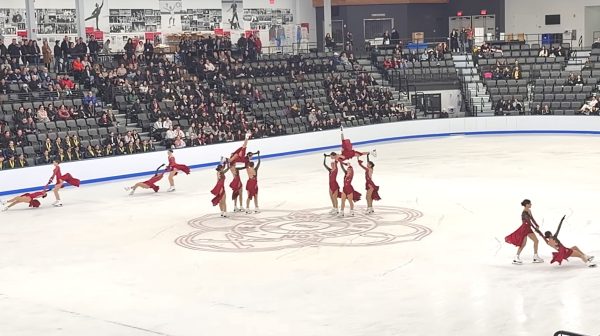
A large part of synchronized skating is pair elements, and many tricks are done in pairs. 9 is not an even number, so pair elements might not be able to be executed.
Molly McMahon, a former member of the Haydenettes, who’s now a current coach for Skyliners Novice and assistant coach for Skyliners Junior, shares her thoughts as well.
“We’re used to even numbers of skaters, 16 at a time. So, we’re used to doing those pair elements with even numbers. I think they’re going to get rid of the pair focus, and I honestly think it could be a representation of what people would call cheerleading on ice,” McMahon said.
Synchronized skating is not just about athleticism and lifts, but also art. “Cheerleading” is very different from the sport skaters are used to.
The community also complains about 9 skaters being too exclusive and not everyone getting a fair chance to participate in the games.
Audrey Chiu, a member of the US national team, has her opinion on this.“At least 12 skaters. The sport will only benefit the people who skate on it, not the many others who won’t make it,” she said.
This is almost half the number of usual skaters, which means half the number of athletes waiting for an opportunity to finally get into the Olympic Games.
“I think Synchro 9 won’t look as serious, and I don’t get the format. I feel like it’s turning into something it’s not,” Chiu said.
With the restricted number of skaters, the entire nature of the sport may change, and may become more like “cheerleading on ice” as McMahon expressed above.
Is Synchro 9 the way for such a passionate community to debut in the Olympics? Or is it going to damage the beauty and talent behind the sport? McMahon expresses her feelings about this.
“I think getting it into the Olympics is a huge move forward for our sport. We’ve been trying for years to get our discipline into the games. I think it’s going to be different, and I think it’s going to be a lot harder than what we’re used to,” she said.
It could all be worth it in the end. Synchro 9 is just a transition that has its costs of difficulty and change.
On the contrary of all the downsides the community is describing, there are some benefits as well.
It will be simpler, a change, more digestible to the audience, and a lot cheaper. The sport is very difficult to fund due to the large number of team members.
This introductory discipline will also allow for new elements in the sport, such as less pair tricks and more jumps. It will also allow for more room to fly across the ice and cleaner shapes.
“It’s going to be a much smaller look, but I think we’re going to see a huge gain in speed as people are flying across the ice with more room to do so. And, we could see some really elite jumps and some elite acrobatic tricks. It’s going to be something that nobody has ever seen before,” McMahon said.
The sport is always changing, getting more difficult with different rules each year. Synchro 9 will just be a huge transformation.
Synchronized skaters just want the sport to become recognized in a way that reflects their passion, beauty, and hard work accurately. Especially if it is debuting in the Olympic Games. They worry that Synchro 9 cannot properly embody the sport.